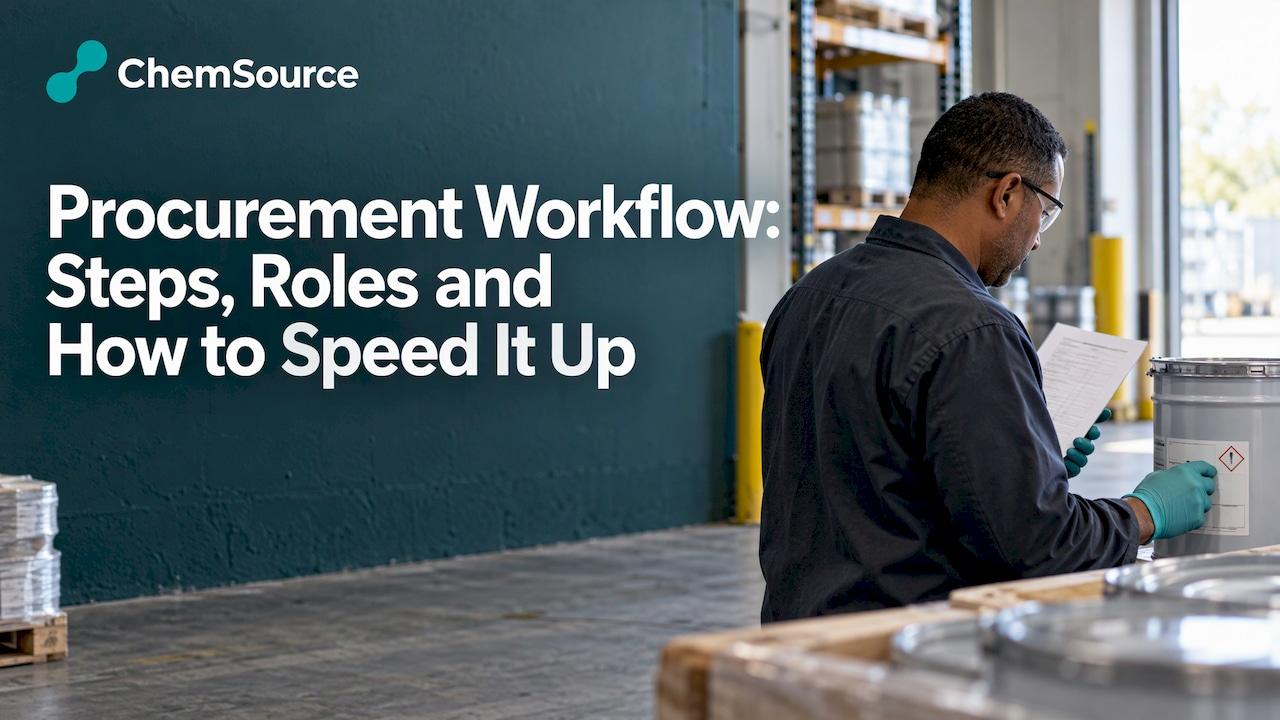
Procurement Workflow: Steps, Roles and How to Speed It Up
A procurement workflow is the repeatable path one purchase takes through your company: who requests it, who approves it, how it becomes a binding order, and how it gets paid. For most teams the slowest stage is not approval or payment but sourcing, the stretch where someone hunts for suppliers, emails them and waits. For chemical buyers that stage is where we focus: you enter a CAS number and your specifications, and ChemSource’s AI agent runs the supplier outreach and returns a curated shortlist within 24 to 48 hours, so the rest of your workflow starts with qualified candidates instead of a blank search.
This guide walks through the full workflow in order, shows where each step goes wrong, and explains what to measure so you know a change actually helped.
TL;DR
- A procurement workflow is the mechanical path of one purchase: requisition, approval, sourcing, purchase order, receipt, invoice match, payment.
- The workflow is narrower than the procurement process. The process covers strategy and supplier management; the workflow is the sequence and approval routing a single order follows.
- Most of the delay in chemical purchasing sits in supplier discovery and first-round outreach, and that is the stage that automates best for specified materials.
- Pick one scope, measure two or three numbers (such as requisition-to-PO cycle time), change one thing, then re-measure.
- ChemSource turns a CAS number and specs into a vetted shortlist in 24 to 48 hours, starting at $69 per month.
Table of Contents
- Procurement workflow vs. procurement process
- The nine steps of a procurement workflow
- Who does what: roles and handoffs
- Direct vs. indirect purchases need different routes
- Where sourcing and qualification fit for chemicals
- Fixing the slowest step: supplier sourcing
- What can be automated across the whole workflow
- Map your own workflow, then measure it
- Where ChemSource fits
- FAQ
- Sources
Procurement workflow vs. procurement process
The two terms get mixed up, and the difference matters when you decide what to fix.
The procurement process is the broad discipline: identifying needs, researching and evaluating suppliers, negotiating, tracking supplier performance. Purchasing, the transactional act of creating and placing orders, is one part of it. The workflow is the narrower, mechanical layer: the exact route a request travels, with its approvers, thresholds and handoffs.
A practical way to use the distinction: if purchases are late because nobody knows who signs off, you have a workflow problem. If purchases are late because you cannot find a supplier who can deliver the grade you need, you have a sourcing problem, and no amount of approval routing fixes it.

The nine steps of a procurement workflow
The Chartered Institute of Procurement & Supply (CIPS), the UK-based professional body for procurement, lists nine steps in the procure-to-pay cycle. Company ERP systems label them differently, but the sequence is the same. Here is each step, what it takes, and where it usually fails.
1. Identify the need
The requesting team defines what it needs, in what quantity, by when, with stakeholder input and a specification. For chemicals, the specification is the whole game: CAS number, grade, purity, packaging, required documents such as a Certificate of Analysis (a supplier’s batch test report), and delivery location.
Where it goes wrong: vague specs. A request that says “acetonitrile, HPLC grade” without purity, water content or packaging size produces quotes you cannot compare. Write the spec once, completely, and reuse it.
2. Create the purchase requisition
A requisition is the formal internal request to buy. It is what puts the need on record and into the approval route.
Where it goes wrong: intake. A need that never becomes a requisition never enters the workflow, and that is how untracked spend happens. Make the requisition the only door, and keep the form short enough that people use it.
3. Approve the requisition
Department heads or budget owners review the request against budget and spending limits. Routing by dollar threshold is the common design: small orders go to a team lead, larger ones to finance or an executive.
Where it goes wrong: every request travels the same long path. Set thresholds so low-value, repeat purchases clear quickly and only high-value or new-supplier requests get extra review.
4. Source and select the supplier
This is where SAP’s procurement course places supplier identification, drawing on requests for information, databases, referrals, trade shows or past contracts, followed by quotes, evaluation and negotiation. Many simplified workflow diagrams fold this into one box. In practice it is the longest stretch for specified materials.
Where it goes wrong: manual scanning of marketplaces, then days of first-round emails to find out who actually has stock, who answers, and who can supply the documentation. Much of that effort goes to suppliers who turn out not to qualify. We cover how to compress this stage in a section below.
5. Issue the purchase order
The approved requisition becomes a purchase order (PO). Once the vendor accepts it, CIPS notes that it activates a legally binding contract, so price, quantity, grade, incoterms and delivery date should all be on the PO and match what was quoted.
Where it goes wrong: specs or terms on the PO that differ from the quote. Copy them from the agreed quote rather than retyping.
6. Receive and inspect the goods
The receiving team checks the delivery against the PO and contract terms. For chemicals that means checking labels, lot numbers, quantity, packaging condition and the Certificate of Analysis for the lot you received.
Where it goes wrong: receiving that is not recorded in the system, which breaks the invoice match later.
7. Evaluate supplier performance
CIPS lists performance evaluation on quality, time, services and responsiveness, with non-performance flagged in the system. This is the feedback loop that makes the next sourcing round faster, because you start with suppliers whose record you know.
8. Approve the invoice
The supplier’s invoice is checked against the PO and the receipt, the so-called three-way match. Prices, quantities and payment terms must agree. Accounts Payable validates supporting documents and resolves discrepancies.
9. Pay the vendor
Finance pays according to the agreed terms. Paying on the right date, not earlier or later, protects both cash flow and any early-payment discount.
Who does what: roles and handoffs
Workflows stall at handoffs. Emory University’s procurement process guide is a clear example of the split. The requesting department identifies the need, supplies technical specifications, enters the requisition, and confirms receipt and approves invoices. Procurement develops requirements, identifies multiple sources, runs competitive bidding and negotiates. Accounts Payable validates invoices, checks supplier setup including tax and banking information, and resolves discrepancies.
Apply the same split to your own team and write it down:
| Stage | Requester / lab | Procurement | Finance / AP |
|---|---|---|---|
| Need and specification | Owns | Reviews | |
| Requisition and approval | Submits | Routes | Budget check |
| Supplier search and quotes | Provides technical input | Owns | |
| PO issued | Owns | ||
| Receipt and inspection | Owns | Informed | |
| Invoice match and payment | Confirms receipt | Resolves disputes | Owns |
The handoff that most often drops is the technical one: the lab knows the grade it needs, procurement knows the market, and the spec gets lost between them. A single spec template that both sides sign removes most rework.
Direct vs. indirect purchases need different routes
Not every purchase deserves the same path. Direct procurement covers raw materials and components that go into your product. Indirect procurement covers supplies that keep the business running. Direct purchases carry supply-disruption and quality risk, so they justify a deeper sourcing and qualification step. Indirect purchases usually belong on a fast, low-touch route.
For a manufacturer or lab, that means at least two workflow variants:
- Repeat, low-risk consumables from approved suppliers: short route, threshold-based approval, no new sourcing.
- New or critical materials, or a new supplier: full route with specification review, supplier qualification and documented selection.
Where sourcing and qualification fit for chemicals
For regulated or specified materials, picking a supplier is a quality decision as well as a commercial one. The United States Pharmacopeia (USP) General Chapter <1083> defines supplier qualification as a risk-based evaluation of suppliers on three things: the risk to product quality, the compliance of their quality systems with regulations and the quality agreement, and their reliability in avoiding quality deviations and shortages. Its steps run from identification and selection through evaluation and acceptance (documentation review, audit, sample analysis) to performance monitoring and, where needed, disqualification.
Two practical consequences for your workflow:
- Qualification belongs before the PO, not after. Build it into the supplier selection step, so the PO goes only to a supplier who has cleared your documentation checks.
- Match the depth to the risk. A commodity solvent used in cleaning needs a lighter review than an excipient or an intermediate that ends up in a finished product. Labs that audit vendors regularly often borrow checklists from vendor audit practices for labs to decide what to verify on paper and what to verify on site.
For a step-by-step on the documents and reviews involved, see our guide to the supplier qualification process.
Fixing the slowest step: supplier sourcing
If you time ten recent chemical purchases from request to PO, you will likely find most of the elapsed days between “need approved” and “supplier chosen.” That stage has three parts: finding candidates, confirming availability and documents, and first-round price discussion. All three are repetitive, which is why they respond well to automation.
Here is how that stage looks in two versions.
| Sourcing task | Manual | With ChemSource |
|---|---|---|
| Find candidates | Scan marketplaces and directories by hand | You enter the CAS number and specs; the AI agent searches across global chemical marketplaces |
| Confirm availability | Email each supplier and wait | Automated outreach verifies availability |
| First-round communication and negotiation | Buyer writes and tracks each thread | AI agents handle the first round |
| Result | A pile of replies to sort | A curated shortlist of qualified suppliers in 24 to 48 hours |
Our positioning is that this gets you to a shortlist 15 times faster than manual search, with real-time data enrichment so the suppliers on it are verified and responsive before you start final negotiations. Your team still makes the buying decision; it just starts from candidates instead of from a search.
The workflow effect is easy to picture. Steps 1 to 3 stay as they are. Step 4 shrinks from a multi-day search into a short review of a shortlist. Step 5, the PO, follows sooner. Because the sourcing is automated, a team can handle more CAS numbers without adding headcount. If your wait between approval and PO is what hurts, our article on measuring and shortening procurement lead time shows how to break it into stages, and our supplier negotiation strategies cover the conversation that follows the shortlist.
What can be automated across the whole workflow

Automation is not limited to sourcing. McKinsey’s analysis of the source-to-pay value stream found 56 percent of tasks fully or largely automatable with technology available at the time of the 2017 report. The shares differ by stage: 88 percent for placing and receiving orders, 93 percent for payment processing, and 47 percent for vendor selection and negotiation.
The pattern is useful for deciding what to automate first:
- Transactional stages (PO creation, receipt, invoice matching, payment) are the most rule-based and the most automatable.
- Vendor selection and negotiation still show close to half of tasks automatable, and they are where a chemical buyer’s elapsed time piles up.
In a later report, McKinsey described a chemicals company that replaced 60 percent of invoice-processing labor with bots that scan and code invoices into its ERP, cutting costs on the automated tasks by 80 percent. The same report notes a chemicals firm that uses highly automated buying channels for simple orders and consolidates complex requests in central expert teams. That is the two-lane design described above, in practice.
Map your own workflow, then measure it
Before changing anything, find out where time actually goes. The steps below follow the logic of the improvement guidance in APQC’s benchmarking advice and the Harvard Government Performance Lab’s procurement data guide.
- Choose one scope. For example, new-supplier chemical purchases, or repeat consumables. A whole-process project rarely finishes.
- Pull ten recent purchases. Record the date of each stage from your system or email trail: requisition, approval, supplier chosen, PO, receipt, invoice, payment.
- Compute stage durations. The Government Performance Lab suggests tracking average days per stage. The longest stage is your target.
- Choose two or three metrics. APQC groups useful measures into cost (such as cost per PO), cycle time (sourcing event, PO issuance, procure-to-pay), process efficiency (share of electronic approvals, maverick buying) and supplier outcomes (delivery performance). Keep the scorecard small enough that someone acts on it.
- Change one thing. Shorten the approval route, standardize the spec template, or automate supplier outreach.
- Re-measure and keep the gain. Update the written policy so the new route is the default.
A simple starting set for a chemical buyer: requisition-to-PO cycle time, days from approval to shortlist, and share of spend with pre-qualified suppliers. If sourcing days drop but PO time does not, your bottleneck has moved to approval, and that is useful to know.
Where ChemSource fits
ChemSource is a subscription platform for teams that buy chemicals. Plans are tiered by the number of CAS searches and user seats, billed monthly or annually. The Starter plan is $69 per month and the Professional plan is $299 per month; Enterprise is a custom plan. Features include supplier discovery, automated outreach and negotiation, real-time data enrichment, benchmarking and team collaboration. If sourcing is the slowest stage in your workflow, you can compare the plans on the ChemSource pricing page and run your next CAS number through it.
FAQ
What is the difference between a procurement workflow and a procurement process?
The process is the full discipline: needs, supplier research, negotiation and performance management. The workflow is the specific route one purchase takes, including who approves it and how it becomes an order. Fix the workflow when approvals and handoffs are slow, and fix sourcing when finding suppliers is slow.
How many steps are in a procurement workflow?
It depends on the source. CIPS lists nine steps from need identification to vendor payment, while others group them into six to eight. What matters is that you cover requisition, approval, sourcing, PO, receipt, invoice match and payment, and that each has a named owner.
Which part of a chemical procurement workflow is slowest?
Usually supplier sourcing, because it involves finding candidates, confirming stock and documents, and a first round of negotiation. Time ten recent purchases to confirm it in your case. With ChemSource, you enter a CAS number and specs and receive a shortlist within 24 to 48 hours.
What should I measure to improve my procurement workflow?
Start with two or three measures, such as requisition-to-PO cycle time, procure-to-pay cycle time and maverick spend. Write down how each is calculated, track it over several months, then change one thing and re-measure.
Sources
- CIPS: Procure to pay process
- SAP Learning: Introducing procurement
- Emory University: Procurement process guide
- USP General Chapter <1083>
- McKinsey: A road map for digitizing source-to-pay
- McKinsey: A next-generation operating model for source-to-pay
- APQC: Benchmarking procurement and sourcing performance
- Harvard Government Performance Lab: Using data to improve procurement
- Peptide vendor audits