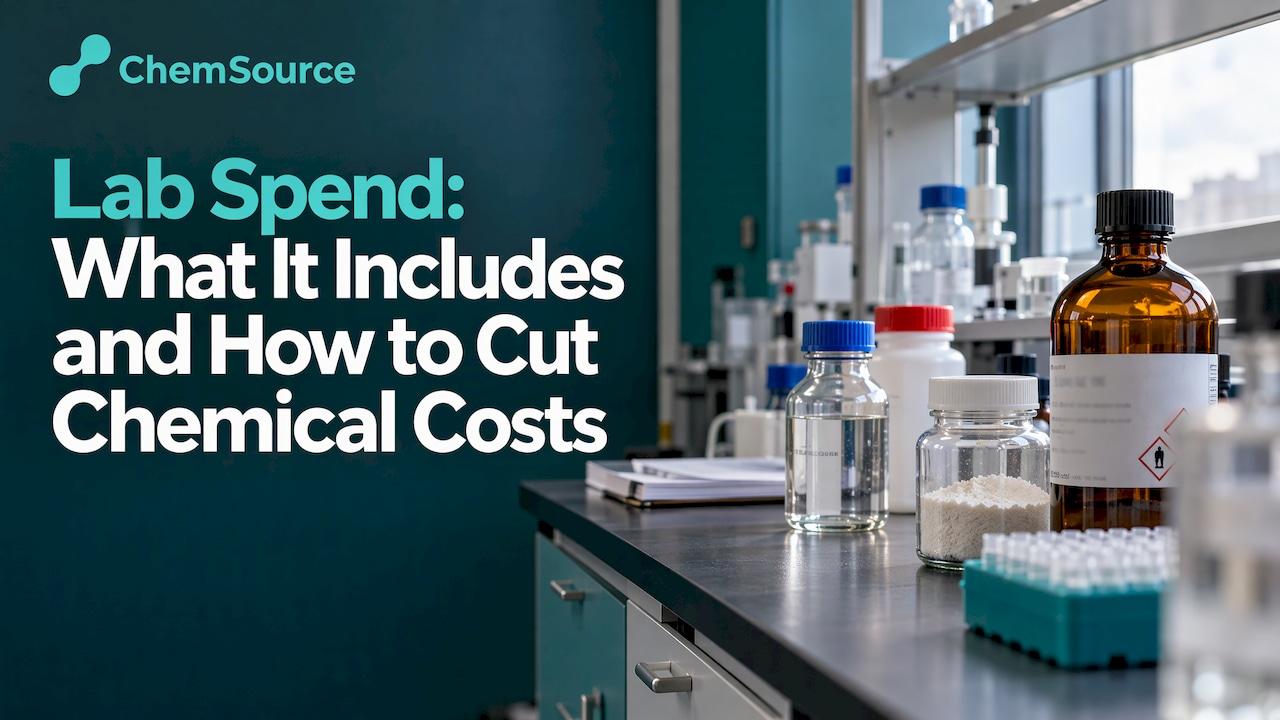
Lab Spend: What It Includes and How to Cut Chemical Costs
Lab spend is everything a laboratory pays to keep testing or research running: people, equipment, space, informatics and the chemicals, reagents and consumables used every day. People usually cost the most. Chemicals and consumables are where a procurement team can move the number fastest, because supplier search, outreach and first-round negotiation can be sped up. We built ChemSource for that step: you enter a CAS number and specifications, and you get a shortlist of qualified suppliers within 24-48 hours.
TL;DR
- Lab budgets typically split into personnel, equipment, repair and maintenance, space and utilities, informatics, consumables, and travel and training. Personnel is usually the largest line.
- Chemical and consumable costs rise with test volume and with purity, compliance and supply-resilience requirements, so track price and volume separately.
- Start with your biggest categories, compare suppliers on price, lead time and qualifications, and manage inventory so nothing expires unused.
- The slowest part of chemical purchasing is finding and vetting suppliers. Automating it saves time, which is a cost too.
Table of Contents
- What lab spend includes
- Why chemical and consumable spend keeps rising
- How to measure and track lab spend
- Where chemical spend leaks
- Cutting costs without hurting quality or supply
- Where automation fits
- FAQ
- Sources
What lab spend includes
Lab managers commonly organize budgets into personnel, equipment, repair and maintenance, space and utilities, informatics, consumables, and travel and training. For most labs, personnel is the biggest slice, and the same source says many labs spend more than 50% of revenue on people and benefits. The MLS/ASCP budgeting guidance puts labor at often 50-60% of a laboratory’s total budget.
The WHO’s guidance on procuring diagnostics frames a testing budget in four parts: infrastructure and administrative overhead, personnel, reagents and consumables, and equipment. Reagents and consumables are repeating costs. An analyzer may be a one-off purchase or be offset through reagent rental agreements.
The mix depends on the lab. In one activity-based costing study of a clinical laboratory in Iran, consumables were the largest single cost at $237,382, or 37% of $641,645 in total 2015 costs, with personnel at 36.3%. Treat it as an example of how close the two can be, not as a US benchmark.
For a procurement team, the useful split is between spend you can influence quickly (chemicals, reagents, consumables) and spend that changes slowly (headcount, space).
Why chemical and consumable spend keeps rising
Two forces push these lines up.
Volume. Supplies and reagents are volume-dependent: when test volume goes up, supply costs go up with it.
Price. A Lab Manager survey reported by MarketScale found 94% of labs call cost reduction a significant concern when buying. Within 12 months, 70% of labs planned to buy chemicals, and respondents reported rising costs on almost everything from reagents to shipping. The same coverage argues that flat consumables spending during a price rise probably means the lab is buying less.
An industry analysis of life science consumables pricing lists the drivers behind that pressure: higher purity and compliance requirements, premiums for dual sourcing and safety stock, validation and change-control costs, and energy, cold-chain and sterile-logistics costs.

The practical lesson is to report price and volume separately. If a budget line grew 8%, you need to know whether you paid more per unit or bought more units. Only the first is a sourcing problem.
How to measure and track lab spend
- Build the category map. Assign every purchase to one of the budget categories above. Put chemicals and reagents in their own lines, not under general supplies.
- Rank by size. Former Intertek VP Sherri Bassner’s advice, as cited by Lab Manager, is to pay attention to the law of large numbers: work on the biggest categories first, where leverage and visibility are greatest.
- Track unit price by CAS number. For chemicals, the CAS number identifies the substance, so price per kilogram or liter for each CAS number, grade and supplier is the cleanest comparison. Keep purity grade and pack size in the same record.
- Separate price from volume. Record quantity bought and price paid each quarter, so a budget request can show what drove the change.
- Capture the hidden costs. Per-unit pricing also depends on import mode, service, logistics and vendor-managed inventories, according to a peer-reviewed network study. Rush shipping and expired stock belong in the picture.
- Forecast the cash. Volume-driven supply costs hit cash on a schedule set by payment terms. A guide to forecasting business cash flow shows how to project what is due over the next 30 days and month by month. It is written around UK small businesses, but the method of tying payables to a forward view carries over.
If you already run a procurement workflow, these records come out of it. If you don’t, the CAS-level price log is the first thing to start.
Where chemical spend leaks
Single-source buying. Without a second quote, you cannot tell whether a price is high. Comparing prices across suppliers is one of the sourcing practices Grand View Research lists, along with product range, guaranteed lead time and post-sales technical assistance.
Duplicate and fragmented orders. One case study reported a diagnostic network cut chemistry reagent overhead by 28% through consolidated deals, after finding expired kits at one site while another site 20 miles away paid overnight shipping for the same kits. Treat it as one illustrative report, not a promise.
Expiry and poor storage. The WHO laboratory quality guidance says careful inventory management prevents waste from improperly stored or expired reagents. A Japanese hospital study found that dedicated inventory software cut inventory value from ¥6.29M to ¥4.61M and raised reagent turnover from 6.2 to 9.1 cycles a year.
Slow sourcing. When finding a qualified supplier takes weeks, teams settle for the first acceptable quote or pay for rush delivery. Our guide on procurement lead time covers how to measure and shorten it.

Cutting costs without hurting quality or supply
The WHO purchasing guidance describes purchasing as a relationship. It advises you to define criteria for supplies, weigh supplier qualifications and credibility against price, consider generic versus brand-name items, and evaluate vendors after purchase, not only before. Contracts should address payment, reliable availability and delivery, and penalties for ending the contract.
A workable routine:
- Write the specification first. CAS number, grade, purity, packaging and required documents. Vague specifications produce quotes you cannot compare.
- Qualify before you negotiate. Our supplier qualification guide lists steps, documents and reviews.
- Negotiate on total cost. Price per unit, lead time, minimum order and payment terms together. See our supplier negotiation strategies.
- Keep a second qualified supplier. Resilience has a price, but a qualified alternative is cheaper than a stockout.
- Review each supplier after delivery. Did the goods match the specification, on time?
The broader chemical procurement guide walks through the full buying cycle.
Where automation fits
The most repeatable, least valuable work in chemical purchasing is scanning marketplaces and running first-round emails to find out who has stock. Our platform automates supplier discovery, outreach, negotiation and real-time data enrichment across multiple global chemical marketplaces. Enter a CAS number and specifications, and the AI agent contacts suppliers to verify availability, then returns a vetted shortlist within 24-48 hours. We position this as sourcing qualified suppliers 15 times faster than manual search.
That speed matters for lab spend in two ways. Your team’s hours go to final negotiation and qualification instead of searching, and with more suppliers compared per CAS number you have a stronger basis for price. Teams can also scale sourcing without additional hiring, which keeps the largest budget line, personnel, from growing with volume.
Plans are tiered by CAS search count and user seats, with monthly or annual billing. Starter is $69 per month, Professional is $299 per month, and Enterprise is custom-priced. See the plans.
FAQ
What is included in lab spend?
Lab spend covers personnel, equipment, repair and maintenance, space and utilities, informatics, consumables, and travel and training. Personnel is usually the largest share. For procurement teams, chemicals, reagents and consumables are the lines most open to sourcing improvements.
Why does my chemical and reagent spend keep growing?
Usually a mix of higher volume and higher unit prices. Purity and compliance requirements, safety stock, validation costs and logistics all add to price. Track quantity and price per CAS number separately to see which is driving your line.
How do I find avoidable lab costs?
Rank categories by size, then examine the largest. Look for single-source purchases, fragmented orders, rush shipping and expired stock. A price log by CAS number makes these visible quickly.
How can I reduce chemical costs without risking quality?
Set clear specifications, qualify suppliers before ordering, compare several quotes on total cost and review each supplier after delivery. We built ChemSource to deliver a vetted supplier shortlist within 24-48 hours so more comparison fits into the time you have.
Sources
- Effective Cost Management in Labs, Lab Manager
- MLS/ASCP hematology budgets
- WHO guidance for procurement of in vitro diagnostics
- Cost-price estimation of clinical laboratory services (PMC)
- Lab Manager survey via MarketScale
- Life science consumables price trends
- The network approach to laboratory procurement (PMC)
- Grand View Research lab supplies procurement report
- WHO LQMS purchasing and inventory guidance
- Inventory software study, Journal of the Japanese Association for Medical Technology
- Diagnostic laboratory network case study