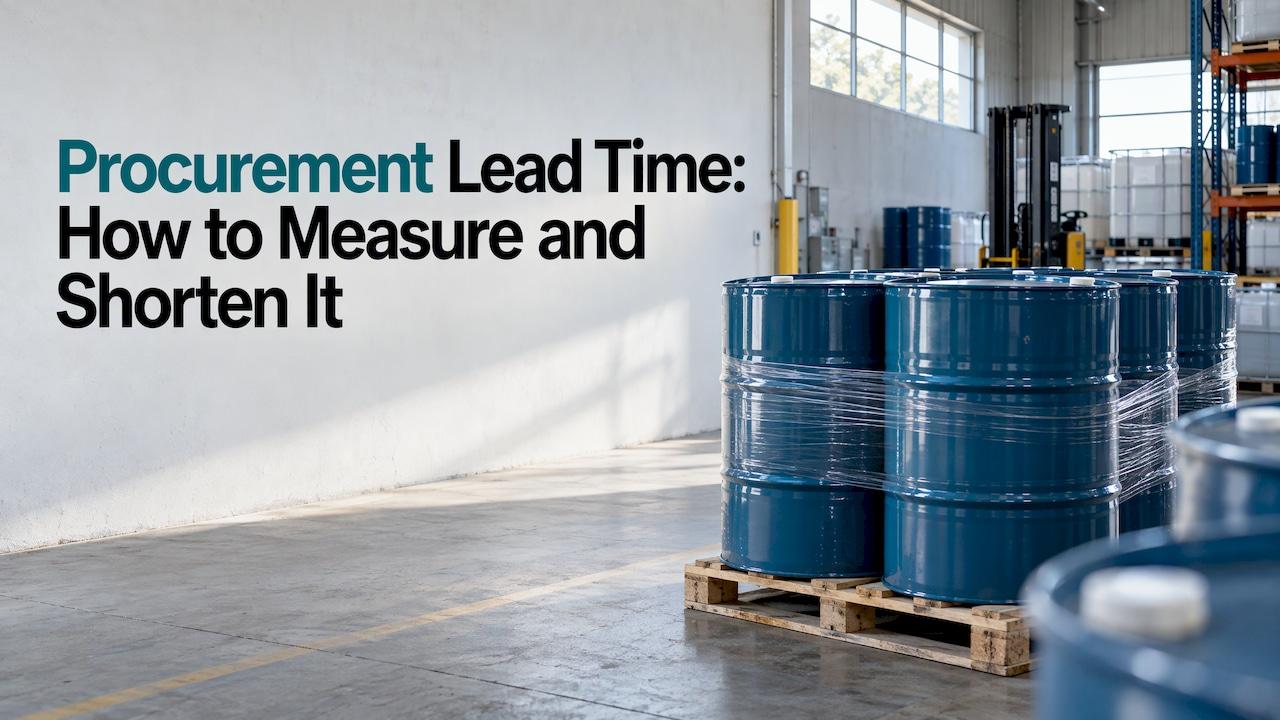
Procurement Lead Time: How to Measure and Shorten It
Procurement lead time is the total time from the moment you need a material to the moment it is received and ready to use. Most teams start the clock at the purchase order. For chemicals, the biggest delay often sits before that: finding qualified suppliers, confirming availability and running the first rounds of emails. Measure that stage, compress it, and your whole lead time moves. ChemSource does this part: enter a CAS number and your specifications, and you receive a curated shortlist of qualified suppliers within 24-48 hours.
TL;DR
-
Procurement lead time covers everything from request to receipt: approvals, supplier selection, order confirmation, production, shipping, receiving and inspection.
-
Supplier lead time is a subset: the time from purchase order to delivery. APQC’s benchmark median is 10.0 days, but the spread between companies is wide.
-
Track averages and variability per supplier and per stage. The most unpredictable stage, not always the longest, drives safety stock and expediting.
-
The pre-order stage (finding, vetting and contacting suppliers) is the easiest to shorten with automation.
-
ChemSource automates supplier outreach and delivers a vetted shortlist in 24-48 hours, with plans from $69 per month.
Table of Contents
What procurement lead time actually means
The terms get used loosely, so fix them first.
Supplier lead time is the elapsed time from the moment a purchase order is transmitted to the moment the delivery is received. APQC, which benchmarks this across thousands of companies, defines it exactly that way. Its benchmark of 3,077 companies reports a median of 10.0 days for purchased materials.
Procurement lead time (also called purchasing lead time) is wider. It starts when someone in your company raises a need and ends when the goods are received, inspected and usable. It includes:
-
Specification and requisition
-
Internal approvals
-
Supplier discovery, qualification and negotiation
-
Order confirmation and supplier preparation or production
-
Shipping and, for cross-border orders, customs
-
Receiving and inspection
The difference matters because a supplier can be perfectly punctual and your procurement lead time can still be painful. If it took three weeks to find a supplier who actually had the grade you needed, the supplier’s 10-day delivery is not your problem.
The other phrases readers use, “purchasing lead time” and “supplier lead times,” map onto the same idea at different scope. Purchasing lead time is your end-to-end figure. Supplier lead times, in the plural, are the per-supplier numbers you compare against each other.
How to calculate purchasing lead time
The simplest working formula splits the journey into three blocks:
Purchasing lead time = pre-processing time + processing time + post-processing time
-
Pre-processing: requisition, approvals, supplier search, vetting, quotes, negotiation, purchase order creation.
-
Processing: the supplier’s order confirmation, preparation or production, and packing.
-
Post-processing: shipping, customs, receiving, inspection and putting material into stock.
A worked example for a specialty chemical ordered from overseas:
| Stage | Days |
|---|---|
| Requisition and internal approval | 2 |
| Finding suppliers, checking availability, first-round outreach | 10 |
| Quote comparison and negotiation | 4 |
| Supplier order confirmation and preparation | 5 |
| Transit and customs | 12 |
| Receiving and quality inspection | 2 |
| Total procurement lead time | 35 |
These numbers are illustrative, not a benchmark. The point is the shape: the supplier’s own lead time (preparation plus transit) is only part of the 35 days. The 10 days spent on discovery and outreach is time that never appears in a supplier scorecard, yet it is entirely within your control.
How to measure it properly
A single average hides most of what you need to know. Three habits make the number useful.
1. Timestamp every stage
Record when the need is raised, when suppliers are contacted, when the PO is placed, when the goods ship and when they are received and accepted. Without stage timestamps you can only say that something was slow, never where.

2. Segment by supplier and item
APQC recommends segmenting supplier lead-time results by supplier and comparing against peers. Its reported quartiles show how wide the range is: 6.0 days or less at the 25th percentile, 21.0 days or more at the 75th, around that 10.0-day median. A supplier who delivers in 18 days is not necessarily underperforming. It depends on the item, the lane and what your peers see.
For chemicals, segment by CAS number as well. The same compound from two producers, or in two grades, can behave very differently.
3. Track variability, not just the mean
Calculate the average and the standard deviation for each stage, using the 10 to 20 most recent orders per supplier. The stage with the widest spread, not necessarily the longest average, is usually what forces you to hold extra safety stock or pay for expediting. A supplier who always takes 14 days is easier to plan around than one who takes anywhere from 5 to 25.
APQC frames lead time as a process KPI rather than a supplier promise: consistent measurement, scorecards and peer comparison are what expose where improvement is possible.
What makes lead times grow or swing
Most delays trace back to a handful of causes:
-
Slow internal workflows. Approval chains, manual PO creation and email-based requests add days before a supplier hears from you.
-
Supplier constraints. Production schedules, labor limits, backlogs and raw-material shortages.
-
Demand swings. Peaks that hit every buyer at once and push everyone’s orders back in the queue.
-
Trade friction. Tariffs, restrictions and customs holds on cross-border shipments.
-
A thin supplier base. If you know only one or two sources for a compound, any problem with them becomes your problem.
The last one is the quietest. Chemicals are often sourced across global marketplaces, and the list of who can actually supply a given CAS number in your required purity and quantity is rarely obvious. Teams fall back on the same few suppliers because re-running the search is expensive. That habit turns a short supplier lead time into a long procurement lead time every time the usual source is out of stock.
Why lead time costs more than the delay itself
Lead time is not just a scheduling issue. It feeds directly into cost.
Academic work on stochastic lead times finds that variation in processing, inspection, loading, transfer and unloading can create shortages or excess inventory, each with its own added cost. The same research indicates that collaboration between buyer and manufacturer, with synchronized flow, can reduce the combined cost of ordering, setup, holding, transportation and shortages.
A Northwestern and MIT study of global dual sourcing describes total landed cost as including goods, labor, overhead, transportation, customs, duties, taxes and working-capital carrying costs, with working capital strongly dependent on lead time and volatility. The practical lesson: compare suppliers on total landed cost and working-capital exposure, not unit price alone. A cheaper quote with a long, erratic lead time can cost more than a pricier, predictable one.
For a production or pilot plant, the consequences are concrete. A late raw material idles a line. Insurance against that risk is safety stock, and every extra week of buffer is cash sitting in a warehouse, and for chemicals potentially a storage and shelf-life question too.
How to shorten procurement lead time without losing quality
APQC’s recommendations are a solid backbone: measure supplier lead time consistently, put it on supplier scorecards, collaborate with suppliers on delivery performance, use integrated visibility systems and prepare contingency plans. Add the steps below and attack the stages in order of how much time they hold.
Stage 1: Compress supplier discovery and first-round outreach
This is the stage most teams underestimate. Manual discovery means scanning marketplaces, searching directories, writing the same inquiry to a dozen companies, chasing replies and discarding the ones that cannot supply your grade. It is slow, and it is also where results vary most from week to week.
McKinsey reports that digital supplier days using prescreened suppliers, analytics and multivariable negotiation can reduce costs by more than 20% and lead times by 15% in the industrial examples it describes. The common thread is prescreening: the time saved comes from not talking to suppliers who could never have fit.
This is the job ChemSource was built for. You enter the CAS number and your specifications. The AI agent contacts suppliers across multiple global chemical marketplaces, verifies availability, handles first-round outreach and negotiation, and enriches the data in real time. You get a curated shortlist of qualified suppliers in 24-48 hours, which is 15 times faster than traditional manual search by ChemSource’s own measure.
Stage 2: Prescreen on more than price
Speed only helps if the shortlist is good. McKinsey says prescreening should consider product capability, quality assurance, certifications, financial health and reliability, not price alone. Write those criteria into your sourcing template once, so every new CAS number starts from the same bar. Then evaluate bids across cost, lead time and quality together, which keeps negotiations short without sacrificing reliability.
Stage 3: Build a bench, not a single source
A qualified backup supplier for each critical material turns a disruption into a switch rather than a restart. Mixing domestic and international sources balances price against transit time and customs risk. Because a shortlist can be produced in a day or two, keeping a second and third option warm becomes affordable for a small team.
Stage 4: Streamline internal approvals
Set approval thresholds so routine reorders under a set value go through without escalation. Use templates for purchase orders. Agree on who signs off on new suppliers and on what evidence. Internal queues are the cheapest delays to fix because no supplier is involved.
Stage 5: Order smarter
-
Order before peak periods rather than during them.
-
Use long-term agreements for materials you buy repeatedly.
-
Set safety stock to match measured variability, not guesswork.
-
Review minimum order quantities and packaging sizes so you are not waiting for a batch to fill.
Stage 6: Keep scorecards honest
Put lead time, its variability, on-time-in-full delivery and the share of orders you had to expedite on one scorecard per supplier. Review quarterly. Suppliers who improve earn more volume; those who do not become your next sourcing project.
Where ChemSource fits
If your timestamps show that finding and contacting suppliers eats a large share of your procurement lead time, that is the stage to automate first. ChemSource is a subscription platform for chemical procurement: you submit a CAS number and specifications, and the AI agent runs supplier discovery, outreach, negotiation and data enrichment across global chemical marketplaces. The output is a vetted shortlist of qualified, responsive suppliers delivered in 24-48 hours, so your team starts final negotiations with options already confirmed.

Pricing is tiered by CAS search count and user seats, billed monthly or annually. The Starter plan is $69 per month and the Professional plan is $299 per month. Enterprise plans are custom. Because the platform supports data benchmarking and team collaboration, the lead times you collect can feed the scorecards described above. Teams can scale their sourcing volume without adding headcount. See the ChemSource plans to find the tier that matches your monthly search volume.
A simple 30-day plan
-
Week 1: Pull your last 20 purchase orders for your top five materials. Reconstruct each stage from emails and ERP records.
-
Week 2: Calculate average and standard deviation per stage and per supplier. Mark the stage with the widest spread.
-
Week 3: Fix the cheapest delays: approval thresholds, PO templates, a standard prescreening checklist.
-
Week 4: For your highest-risk CAS numbers, run a fresh supplier search to build qualified backups, then set safety stock against the variability you measured.
Repeat quarterly. Lead time is a process you manage, and teams that measure it per stage find the improvements are usually in the steps before the order, not after.
FAQ
What is the difference between lead time and procurement lead time?
Lead time on its own usually means the time between placing an order and receiving it. Procurement lead time is broader: it begins at the internal request and includes approvals, supplier selection and negotiation, then delivery, receiving and inspection. It is the figure your production planners actually experience.
What is a good supplier lead time?
It depends on the material and lane. APQC’s benchmark of 3,077 companies shows a median of 10.0 days for purchased materials, with the best quartile at 6.0 days or less and the slowest quartile at 21.0 days or more. Compare against your own history per supplier and item before comparing against any external number.
How do you reduce lead time for chemical purchases?
Start with the stage you control: supplier discovery and first-round outreach. Prescreen on quality, certifications and reliability, keep qualified backup suppliers per CAS number, and set safety stock from measured variability. ChemSource automates the discovery stage and returns a shortlist in 24-48 hours.
Why do lead times vary so much between orders?
Common causes are supplier backlogs, production schedules, raw-material shortages, demand peaks, tariffs and slow internal approvals. Tracking the standard deviation of each stage shows which cause is hurting you most.