Chemical Supply Chain: Stages, Risks and How to Source Faster
A chemical supply chain is the network that moves a substance from raw material to the plant or lab that uses it: feedstock producers, manufacturers, distributors and carriers. For a buyer, the stage that decides speed and resilience is the first one you control: finding and qualifying suppliers. That is where weeks disappear into marketplace scanning and first-round emails, and where a single-source habit quietly builds risk. Our platform is built to compress that stage: enter a CAS number and your specifications, and an AI agent contacts suppliers and returns a shortlist within 24-48 hours.
This guide explains the chain in plain terms, shows where it breaks, and gives procurement teams, manufacturers and research labs a practical way to make their own link stronger.
TL;DR
- The chemical supply chain runs from raw materials through manufacturing, storage and transport to distribution. Buyers sit in the middle and depend on every stage.
- Most disruption comes from poor material-level visibility, single-source buying and concentrated shipping routes, not from a lack of chemicals.
- Qualifying a supplier is a risk-based process: the closer a material is to your finished product, the deeper the checks should go.
- Having two or three qualified suppliers per critical CAS number is the most direct resilience step a buyer controls.
- Our AI agent automates supplier outreach and returns a curated shortlist in 24-48 hours, so qualification starts from verified candidates rather than a blank page.
Table of Contents
- What the chemical supply chain is
- The flows that matter to a buyer
- Where chemical supply chains break
- What chemical supply chain management involves
- Qualifying suppliers without losing weeks
- A resilience playbook a buyer can run
- Costs: where procurement savings really come from
- Where ChemSource fits
- FAQ
- Sources
What the chemical supply chain is
One industry overview describes the chemical supply chain as the connection of raw materials, chemical suppliers, manufacturers and distributors, moving goods from origin to end user. Raw materials include natural gas, minerals and other chemicals. Suppliers handle sourcing and bulk delivery. Manufacturers turn inputs into finished products. Distributors use transport routes to reach customers worldwide.
Another way to cut it is by stage. A logistics provider’s breakdown lists five: raw material sourcing, manufacturing, warehousing, transportation and distribution, with specialized partners at each. The same source notes that a contaminated shipment or a temperature excursion can destroy a specialty-chemical batch worth tens of thousands of dollars. That is why chemicals are not bought like office supplies.
How big and how varied it is
An academic value chain study reported that the global chemicals market was valued at US$4.2 trillion by 2014, with as many as 100,000 different chemicals produced and specialty chemicals making up 21% of the market. It divides the chain into five segments: feedstock provision, then commodity, intermediate and specialty production, then distribution. Those figures are dated, but the structure still explains why a buyer of a commodity solvent and a buyer of a niche intermediate face very different supplier markets.
Commodity buyers mostly compete on cost and delivery reliability. Specialty buyers care more about grade, documentation and a supplier that will answer questions. Know which category each of your CAS numbers belongs to before you decide how much effort sourcing deserves.
The U.S. physical network
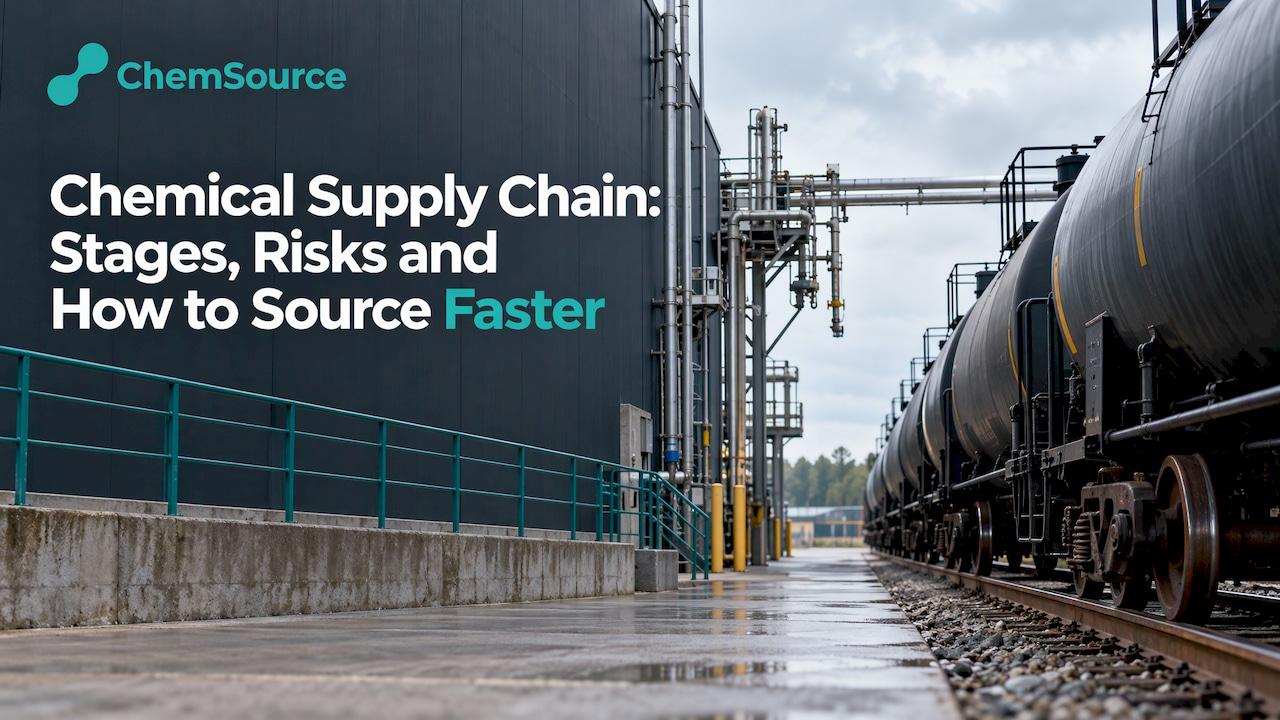
In the United States, the American Chemistry Council notes that chemicals travel largely by rail, in tank cars for liquids and liquefied gases and hopper cars for dry commodities, alongside trucks, barges, pipelines and ports. A buyer rarely controls these modes, but lead times quoted by suppliers depend on them.
The flows that matter to a buyer
A supply chain is not only boxes moving. A Carnegie Mellon paper describes three flows in a real chemical supply chain:
- Material: raw materials, intermediates and finished goods being transported, stored and transformed.
- Information: orders, forecasts, specifications and certificates, governed by the company’s business processes.
- Financial: invoices, payments and balance-sheet effects at each commercial transaction.
The same paper names six end-to-end processes, including source-to-pay and inquiry-to-order. Its argument is that models which look at orders or at manufacturing in isolation produce poor or even infeasible plans, while integrating the flows gives more accurate answers.
For a procurement team the practical reading is simple. Information is the flow you can improve fastest. If you learn availability, grade and lead time in two days rather than two weeks, every downstream plan gets better.
Where chemical supply chains break
Poor visibility and single sourcing
A CAS article on raw material sourcing risk states that manufacturers must trace materials back to their chemical origins to qualify suppliers rigorously and comply with regulations, yet most chemical companies lack material-level visibility. It reports that 73% of companies are advancing dual-sourcing strategies and 60% are regionalizing their supply chains. Its recommended remedies include strategic inventory buffers, supplier-managed inventory, supplier diversification, regional sourcing and distributor networks as secondary channels.
Notice what these have in common: each one needs more qualified suppliers than you have today. Diversification is impossible if finding a second source takes a month.
Concentrated routes and infrastructure
The APEC Resource Guide (April 2026) reports that chemical supply chains lean heavily on ports, pipelines and specialized terminals, and that concentrating trade through a few routes or suppliers amplifies the risk from congestion, geopolitical instability and natural disasters. It also notes that many customs and logistics processes for chemicals lack fast-track treatment.
KPMG’s June 2025 report gives a concrete example: Red Sea conflicts forced ships to reroute around Africa, adding 10 to 15 days to transit and raising fuel costs by 40%. Companies running just-in-time inventory were the most exposed, facing production halts, higher warehousing costs and missed deliveries. The same report describes the industry shifting from efficiency toward resilience, with more sourcing and production located closer to end markets.
Complexity built into the product
An EPCA workshop report attributes chain complexity mainly to four factors: the nature of the product, market requirements, physical process characteristics, and administrative, financial and information flows. The last factor is the one that grows with every extra supplier, certificate and document, and it is the one software can take off a team.
What chemical supply chain management involves
Academic definitions describe supply chain management as managing material, information and capital flows, plus cooperation among the companies along the chain. A review in the Journal of Cleaner Production frames it that way and adds economic, environmental and social goals taken from customer and stakeholder requirements. A Rutgers dissertation stresses that a supply chain is better seen as a network than a line, with flows of information, material and money emerging from local interactions among many parties.
For a buyer, that translates into four recurring jobs:
- Finding suppliers for each CAS number and grade.
- Qualifying them on quality, compliance and reliability.
- Negotiating price, volume and terms.
- Monitoring performance and keeping alternatives warm.
Our chemical procurement guide walks through the whole routine. Here we focus on the first two jobs, because they set the pace for everything after them.
Qualifying suppliers without losing weeks
The risk-based standard
USP General Chapter <1083> defines supplier qualification as a systematic, risk-based evaluation of suppliers on three points: product or service quality risk, quality-system compliance with regulations and contract requirements, and reliability in avoiding quality deviations and shortages. Its lifecycle has six steps: preparation, identification and selection, evaluation and acceptance, performance monitoring, disqualification, and conditional approval.

The key idea is proportionality. The closer a material is to the finished product, the higher the risk, so the depth of evaluation (document review, audit, sample testing) should scale with how critical the material is. A bulk cleaning solvent and an active ingredient should not get the same process.
What to verify on each candidate
Supplier qualification guides from chemical traders converge on a similar list. One 2026 qualification guide recommends confirming:
- Legal and commercial identity: registered name, address, business scope and bank beneficiary.
- Product and source identity: full chemical name, grade, CAS number, production site and country of origin.
- Specifications side by side: every gap in assay, moisture, particle size, pH, contaminants or viscosity marked against your requirement.
- Traceability and change control, then a trial order with incoming testing before you scale volume.
It also lists red flags, such as certificates of analysis (COAs) with identical values across unrelated batches, or certificates that do not identify a relevant site or scope.
Another regional guide adds document specifics. A credible supplier provides a GHS-compliant 16-section safety data sheet (SDS), and a missing or pre-GHS version is a disqualifying red flag. A COA should show product name, CAS number, batch number, test parameters with specifications and actual results, and the manufacturer’s signature or stamp. Ask for conservative lead times, stock status (local or back-to-back) and the complaint process, including whether batch samples are retained for 12 months.
If your suppliers send safety data sheets in another language, a safety data sheet translation guide explains why accurate terminology matters when documents cross borders.
Our supplier qualification guide lists the documents and review steps in more detail.
Where the time actually goes
The checks above are not the slow part. The slow part is everything before them: scanning marketplaces, writing the same inquiry to twenty companies, chasing replies and discovering that half of them cannot supply your grade or quantity. That first-round work is repetitive, and it is what our platform automates. The AI agent runs outreach to verify availability against your CAS number and specifications, and with real-time data enrichment it returns a curated shortlist of qualified, responsive suppliers within 24-48 hours. Your team then spends its hours on the part that needs judgment: document review, samples and negotiation.
By our own measure, this is 15 times faster than manual search. It also lets a team cover more CAS numbers without adding headcount.
A resilience playbook a buyer can run
You cannot reroute a ship, but you can control how many qualified options you hold. A practical sequence:
- Rank your CAS numbers by criticality. Which ones would stop production or a study if they vanished for a month? Those get the deepest qualification and a second source.
- Build a shortlist per critical item before you need it. A shortlist built under pressure is a worse shortlist. Qualified alternates sitting in a file turn a disruption into a phone call.
- Mix geographies. The regionalization trend in the research above is a signal: pair an offshore source with a closer one where the economics allow.
- Measure lead time honestly. Track quoted versus delivered lead time per supplier. Our procurement lead time guide shows how to measure and shorten it.
- Negotiate from a position of options. With several qualified suppliers in hand, price talks change. See our supplier negotiation strategies.
- Review on a schedule. Qualification is a lifecycle, not a one-time gate. Revisit performance, and retire suppliers who slip.
Using data and AI without handing over the decision
The APEC guide recommends investment in digital infrastructure, AI and blockchain to give real-time visibility and better traceability across chemical supply chains. The sensible way to use such tools in sourcing is to let them do the high-volume, repetitive work and keep people on the decisions. This is the same principle as using AI without giving up the call: automation prepares the options, your team chooses the supplier.
Costs: where procurement savings really come from
The Deloitte supply chain report for chemicals argues that a transparent, structured and lean supply chain is essential to stay competitive, and that resilience and integrated business planning help companies cope with market uncertainty. For buyers, savings tend to come from three places:
- Price discovery: more quotes from verified suppliers mean a clearer view of the market.
- Fewer emergencies: qualified backups reduce spot buying at a premium.
- Time: hours saved on first-round communication are hours your team can spend on negotiation and planning.
That is also the reasoning behind commercial sourcing: a structured approach to the commercial side of the chain, not just the purchase order.
Where ChemSource fits
Our platform is built for procurement teams, manufacturers and research labs that buy chemicals commercially. You enter a CAS number and specifications, and the AI agent handles supplier discovery, outreach and qualification across multiple global chemical marketplaces, then delivers a vetted shortlist within 24-48 hours. It also supports data benchmarking and team collaboration.
Plans are tiered by CAS search count and user seats. Starter is $69 per month and Professional is $299 per month; Enterprise is a custom plan with no published price. Billing is monthly or annual. You can compare the plans and start on the ChemSource pricing page.
FAQ
What is the supply chain of the chemical industry?
It is the network that carries chemicals from raw materials such as natural gas and minerals through manufacturers and distributors to end users. Typical stages are raw material sourcing, manufacturing, warehousing, transportation and distribution. Information and money flow alongside the physical goods.
What are the main flows in a chemical supply chain?
The most cited are material, information and financial flows. Material flow covers the physical movement and transformation of chemicals. Information flow covers orders, specifications and certificates, and financial flow covers invoices and payments. Managing all three together gives better plans than optimizing any one alone.
How do I reduce risk in chemical sourcing?
Start with the items that would halt your operation, and qualify at least two suppliers for each. Scale checks to criticality, as USP’s risk-based approach recommends, and keep documents such as SDSs and COAs current. Having a shortlist ready in advance matters most, and our platform is built to produce one in 24-48 hours.
How long does it take to find a qualified chemical supplier?
Manual searching depends on how many marketplaces you scan and how fast suppliers reply, and it often stretches across weeks. With our AI agent, you enter a CAS number and specifications and receive a curated shortlist within 24-48 hours. Final qualification, such as sample testing, follows your own quality procedures.
Sources
- Chemical Supply Chain Management: Solutions & Strategies, Inbound Logistics
- Chemical Supply Chain Disruptions, Redwood Logistics
- Global Value Chains: The Philippines chemical sector
- Integrating information, financial, and material flows, Carnegie Mellon
- Raw material sourcing risk in chemical manufacturing, CAS
- APEC Resource Guide: Building Supply Chain Resilience in the Chemical Sector
- Supply unchained, KPMG
- Sustainable Chemical Supply and Logistics Chains, EPCA
- Sustainable supply chain management in the chemical industry, ScienceDirect
- Graduate Program in Chemical and Biochemical Engineering, Rutgers
- USP General Chapter <1083>
- How to Qualify a Chemical Supplier in China
- How to Qualify a Chemical Supplier in UAE
- Supply chain management in the chemicals industry, Deloitte
- Safety Data Sheet Translation guide
- AI-Assisted Decision Making